
- Call Now (905) 607-7721
Missing a tooth is more than a cosmetic problem. A gap can change how you chew, let
neighbouring teeth drift, and over time contribute to bone loss in your jaw. The two most
common ways to replace a missing tooth are a dental bridge and a dental implant, and patients
often ask which one is better.
The honest answer is that it depends on your mouth, your budget, and your timeline. Here is
how the two options compare.
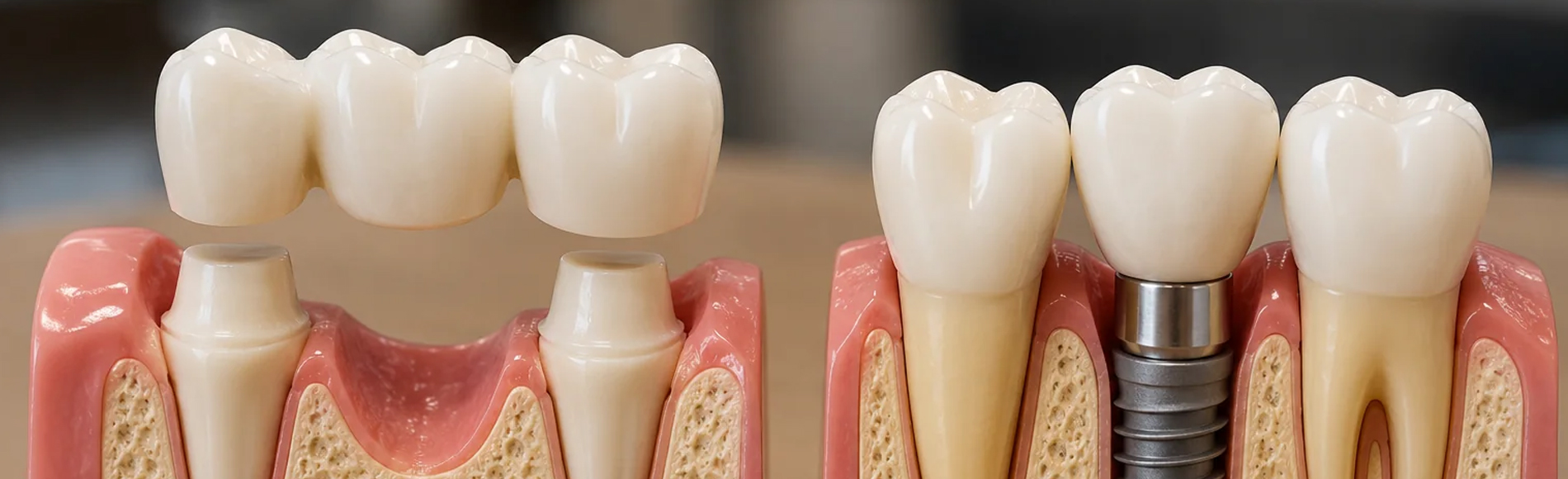
A dental bridge replaces a missing tooth with a false tooth that is anchored to the healthy teeth on either side of the gap. Those neighbouring teeth are shaped down and covered with crowns, which hold the bridge firmly in place.
A dental implant replaces the whole tooth, root included. A small titanium post is placed in the jawbone and, over several months, fuses with the bone. A custom crown is then attached to the post, creating a replacement tooth that stands on its own.
Treatment time. A bridge is usually completed in a few weeks over two or three visits. An
implant takes longer because the jawbone needs time to heal around the post before the final
crown is placed, often several months in total.
Durability. Implants generally last longer than bridges and are easier to keep clean. A bridge
may eventually need to be replaced or re-cemented.
Effect on neighbouring teeth. A bridge requires reshaping the teeth next to the gap, even if
they are perfectly healthy. An implant does not touch them.
Jawbone health. Because an implant replaces the root, it keeps stimulating the jawbone the
way a natural tooth does. A bridge sits above the gum line and does not.
Cost. A bridge usually costs less upfront. An implant costs more initially but may be more
economical over the long run if it avoids future replacement. Insurance coverage varies by plan,
so it is worth checking yours.
Bridges work well when the teeth beside the gap are already healthy or would benefit from
crowns anyway, or when you want a shorter treatment timeline.
Implants require enough jawbone to support the post. If you have lost significant bone, a graft
may be needed first. Smoking and certain health conditions, such as poorly controlled diabetes,
can also affect implant success, so your dentist will review your medical history.
Your dentist will examine the area, take X-rays to assess your bone and neighbouring teeth, and talk through your priorities: speed, longevity, appearance, and budget. From there, you will get a recommendation based on your own mouth rather than a one-size-fits-all answer.
Is an implant more painful than a bridge?
Implant placement is a surgical procedure, so you can expect more soreness in the days
afterward than with a bridge. Most patients manage it with over-the-counter pain relief as
directed by their dentist.
Can a bridge replace more than one missing tooth?
Often, yes. Bridges typically suit one to three missing teeth in a row, provided there are healthy
teeth or implants on both sides to anchor them.
What happens if I leave the gap alone?
Neighbouring teeth can shift into the space, your bite can change, and the bone beneath the
gap can gradually shrink.
If you are deciding between a bridge and an implant, we can examine your mouth and walk you through both options. Call Iris Dental Group in Etobicoke at (416) 201-9660 to book your consultation, or book online.
© Copyright Iris Dental Group All Rights Reserved. Developed by Tas Technologies